SPY is showing a small pre-market pullback while trading close to resistance. MFI remains negative but is starting to turn higher, while flow is still outflow.
Support: $758–763
Resistance: $770–775
50D EMA: ~$761
MFI: Negative, improving
Flow: Outflow
I would remain selective here and focus on adding only long-term names I’m comfortable holding through a deeper correction.
HOLD / SELECTIVE ACCUMULATION ON SUPPORT.
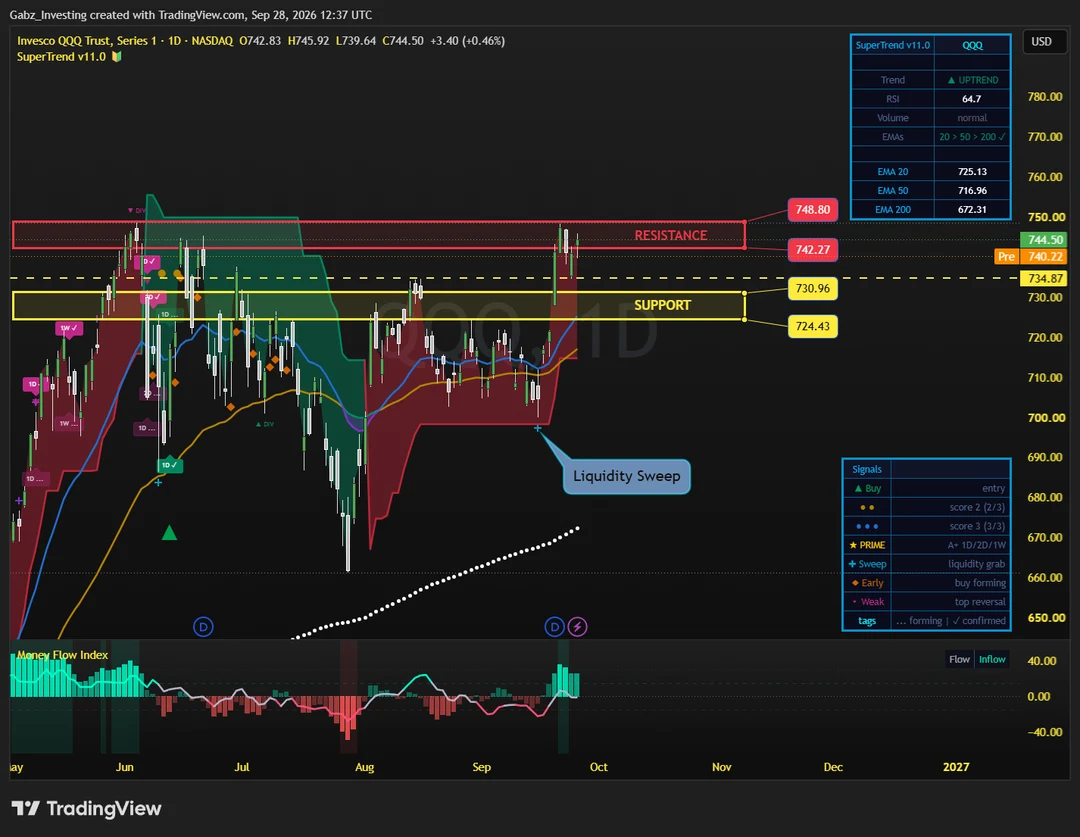
$QQQ — Daily Technical Setup
QQQ remains in a daily uptrend, despite the ~0.5% pre-market pullback. Price is still close to resistance, while MFI is around neutral and flow remains positive with buying volume present.
Support: $724–731
Major Support: ~$735
Resistance: $742–749
20D EMA: ~$725
MFI: Neutral / Slightly Negative
Flow: Inflow
If the correction continues, ~$735 would be the first level I would watch, followed by the broader support zone.
HOLD — BUY ON SUPPORT.
Investing in 2026 looks nothing like investing did in the past
Not because the markets have changed. Because you are hit with more information in a single morning than a professional investor received in an entire month twenty years ago.
And here is the trap almost nobody sees:
The same information that should make you a better investor is exactly what can destroy your account.
Access to information is not the same as clarity. It is noise. It is real-time FOMO. It is watching other people’s gains scroll past every three minutes. It is a single tweet flipping convictions you spent a full year building.
Look honestly in the mirror and answer:
How many of you bought into a speculative company just because “it was going up right now” or just because it was trending on X? You became exit liquidity for someone who knew exactly when to sell. Someone who was counting on your excitement.
Do you need an example? Check $SIDU chart
How many of you sold a good position in panic? Not because the thesis broke. Because the red on the screen became unbearable.
Check $AMD chart in March 2025.
How many of you held a core position down 70% with real calm — not resignation, not denial, actual calm — because you knew the business behind that ticker was growing, generating cash, compounding its competitive edge, and the stock price was nothing more than a temporary illusion of collective fear?
That last question is what separates investors from everyone else.
Because in 2026, the edge no longer comes from knowing more than the crowd. Everyone knows. Everyone has access. Everyone sees the same charts, the same news, the same narratives, in the same minute.
The edge comes from enduring longer than the crowd.
From refusing to confuse volatility with risk. From refusing to confuse consensus with truth. From knowing your companies well enough that a 70% drawdown does not change your thesis — it only changes your cost basis.
Markets do not reward the smartest. They reward the most disciplined.
And discipline, in 2026, is the rarest asset on the market.
The takeaway for you: BUY companies that look fundamentally strong, have a strong competitive MOAT, and whose market valuation becomes disconnected from the underlying business — the stock price goes down while the business continues to improve.
During these periods, accumulate and hold the shares for the long term.
September 20 | WEEKEND MINDSET: INVESTING NEEDS A PLAN, NOT PERFECTION
Good morning, Traders and Investors
Because it’s the weekend and there isn’t much market data to analyze — the market has taken a two-day break as well — today I want us to focus on something that may actually be more important than analyzing another stock: mindset, discipline, and having a clear investment plan.
If I had to build a healthy investment journey from scratch, I would start with one simple thing:
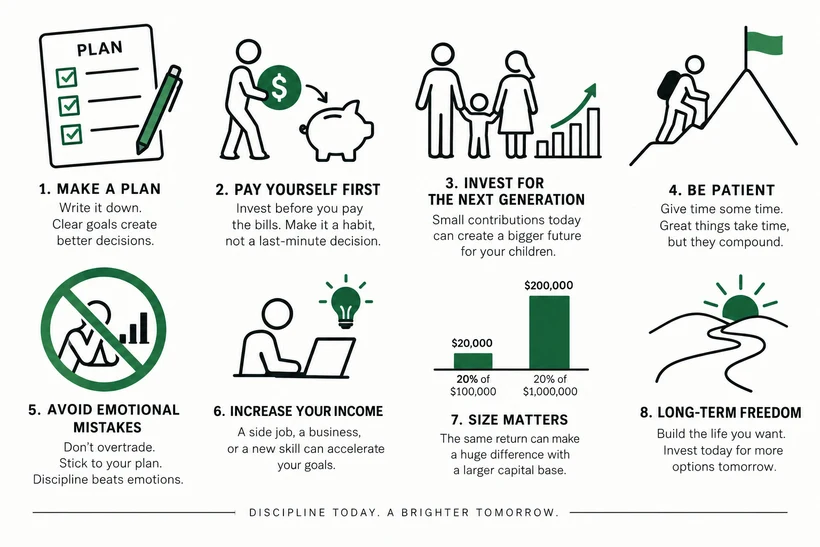
Make a plan.
And I don’t mean anything complicated. Take a piece of paper, old school, and write down:
How much can I invest every month?
What is my target?
How long do I want to take to reach it?
What annual return am I using as an assumption?
What will I do when the market goes down?
What will I do when the market goes up aggressively?
You’ve seen the compound interest calculator I’ve shared with you many times. Use it.
Enter the amount you can invest every month, choose a reasonable annual return assumption, and see what time and compounding can potentially do for your portfolio.
Of course, future returns are unknown. But we still need a framework so we can build a realistic plan.
PAY YOURSELF FIRST
Most people do the exact opposite.
They receive their salary → pay the bills → pay the debt → pay the mortgage → buy groceries → spend money on everything else → and then, at the end of the month, they see what is left for investing.
Very often, there is nothing left.
That’s why I suggest doing something different:
Pay yourself first.
The day you receive your salary, make the transfer to your investment or savings account.
Not at the end of the month.
Obviously, the amount has to be something you can realistically afford. There is no point investing money you need for essential expenses.
Personally, I have always considered 20–40% of a family’s monthly income, where financially possible, an ambitious target for saving and investing.
The important part is this:
Turn investing into a habit, not a decision you have to make every month.
THINK ABOUT THE NEXT GENERATION
Another thing I consider extremely important is building an investment account for your children.
If you have a child who is 1, 2, 3, or 5 years old, time is one of the biggest advantages you have.
You don’t need to start with huge amounts.
You could start with the monthly child allowance, a small recurring contribution, or whatever amount your family can comfortably afford.
This isn’t only about money.
It’s about changing the starting point for the next generation.
If we didn’t have that advantage when we turned 18, that doesn’t mean our children have to start from zero.
Don’t make exceptions every time the market moves in one direction or another.
Because one exception can very easily become a habit.
And long-term investing is, to a large extent, about repeating good habits for a very long time.
And perhaps most importantly:
Be patient.
Give time some time.
You don’t need to constantly buy and sell.
If you own companies you have strong conviction in and your investment thesis remains intact, avoid overtrading simply because you feel like you need to do something.
I have made these mistakes myself.
I sold part of my Palantir position around $30 before it went to $200
I sold part of my Robinhood position around $24 before it went to $100
I sold HIMS around $15 before it went to $70
I sold FROG around $25 before it went to $80
And then?
Some of these companies went on to increase dramatically.
The problem wasn’t only that I sold.
The problem was that I told myself:
“I’ll buy it back lower.”
And sometimes that lower price never came.
DON’T IGNORE YOUR MOST IMPORTANT ASSET: YOUR INCOME
If your current financial situation doesn’t allow you to invest as much as you would like, the solution may not be taking more risk in the market.
The solution may be to increase your income.
A part-time job.
A business.
Turning a passion into an additional source of income.
Learning a new skill.
Anything that can generate additional income that you can then direct toward your financial goals.
Because there is a massive difference between trying to achieve a higher return and being able to invest more money every single month.
MY OWN GOAL
I’m approaching 32 years old, with roughly one month left until my birthday.
My goal for many years has been $1 million. Thanks to this project, I have upgraded my goal to over $2M.
I don’t come from a wealthy family, and I didn’t start with a huge amount of capital. (If I told you that the average salary in my country is around $600, you would laugh or cry.)
I’m trying to build everything on my own.
And if my plan works the way I want it to, my goal is to reach a point around the age of 40 where I have the freedom to decide if, when, and how I want to work.
For me, that’s the real definition of financial freedom.
It doesn’t necessarily mean never working again.
It means not being forced to work simply because you need the next paycheck.
THEN COMES THE POWER OF CAPITAL
Once your portfolio reaches a certain size, the mathematics start to change.
A 20% return on $100,000 is $20,000. (Enough to live for 1 year in my Country)
A 20% return on $1,000,000 is $200,000. (Enough to live at least 5 years with a great lifestyle)
Same percentage.
Completely different capital base.
That’s why, during the first part of the journey, I believe we should focus heavily on:
Contributions + Discipline + Time + Increasing Income.
Later, when the capital becomes large enough, there are more ways to potentially generate cash flow — dividends, options strategies, and other instruments, depending on your experience, risk tolerance, and objectives.
But we don’t need to jump straight to the end of the story.
We need to build the foundation first.
Plan → Contributions → Discipline → Time → Compounding.
That’s what today’s material is really about.
Not what the market will do on Monday.
Not which stock will go up next week.
It’s about you.
About what you can control.
Because the market doesn’t require you to be perfect.
It requires you to avoid making the same emotional mistakes over and over again.
September 5 | One Hot Jobs Number, and Seven Charts Explained
Good morning, beautiful community!
I’m sharing this material for free today to give you a better idea of what you receive as a subscriber. These reports take a significant amount of time and work to put together, and I usually share them with the community once a week, sometimes twice.
The subscription is currently $25/month until early November, when it will increase to $30/month for the Market Update Tier and $60/month for the Beta Tier. I believe the work I put into these reports deserves that adjustment, and I want everyone to have the opportunity to see the value before deciding.
The goal is not just to give you information, but to help you understand how to act, where opportunities may exist, and where market panic or misinterpretation can create an advantage.
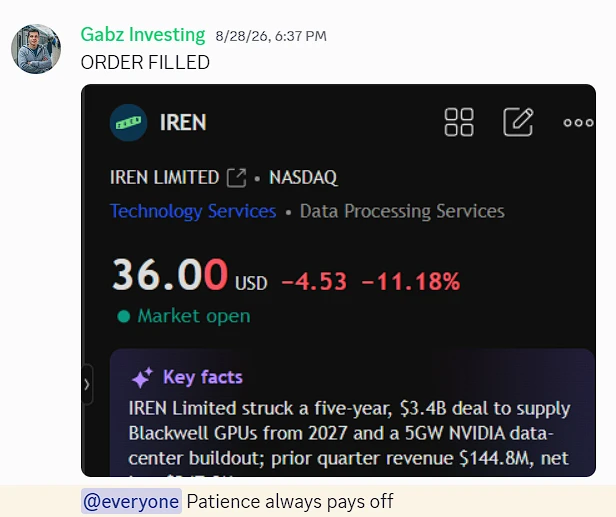
We saw a great example with IREN recently. We added that position at $36, during a period of panic that I believed did not reflect a real reason for concern. Just one week later, we’re looking at returns of more than 25% on that position.
That’s the kind of opportunity I want to help you identify—not by chasing the market, but by understanding it.
If you’re curious about what the community receives, this is a good example of the work that goes into it.
Now, let’s take a closer look at today’s market update…
It’s the weekend, I’ve got my coffee, and I’m sitting here going through the charts one more time before the week starts. I want to walk you through exactly what I’m reading, in plain words, because yesterday gave us a number I did not want to see, and I think the honest thing to do is talk about it openly instead of pretending.
So let me start there.
The jobs report came in the opposite of what I hoped for
On Friday I told you I’d rather see a soft jobs report. Fewer jobs, unemployment ticking up a little. That kind of report keeps the Fed calm and takes a rate hike off the table.
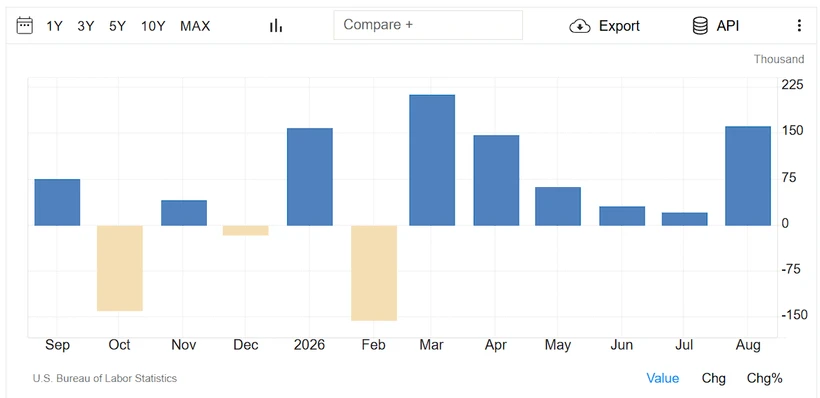
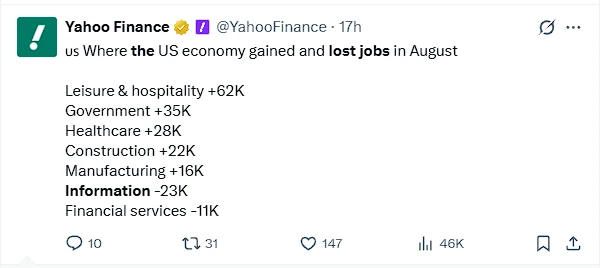
We got the opposite. The US added 162,000 jobs in August, the strongest in five months, and roughly three times what the market expected (around 53,000 to 56,000). Unemployment held at 4.1%. And here’s the part that stings a little: July, which first printed as a loss of 23,000 jobs, was revised all the way up to a gain of 21,000. June and July together were bumped up by 55,000.
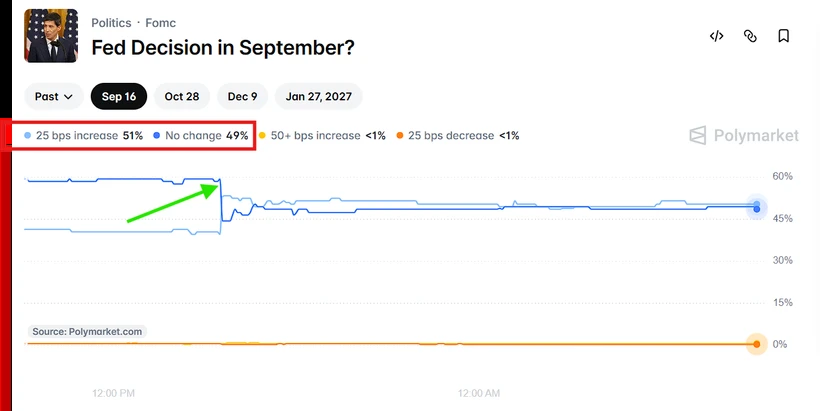
I’m not going to spin this. A hot number like this makes a September rate hike more likely, not less. Right after the report, the market’s odds of a hike jumped from around 55% to about 65% for the meeting on September 15–16. So the thing I’ve been saying for weeks, that the Fed doesn’t hike, is now under real pressure. I still lean that way, but I have to respect what the data did.
This morning’s chart is showing almost 50/50 chances of a 25 bps rate cut and no change. As I’ve stated before, I think rates will remain unchanged.
Two things keep me from panicking, though.
First, look at what kind of jobs these were. The gains came from restaurants and bars, local government schools, and health care. Solid, but not exactly the high-value engine of the economy. And here’s the quiet detail almost nobody is highlighting: the information sector actually lost 23,000 jobs, in computing infrastructure, data processing and web hosting. That’s the tech corner of the labor market shrinking, likely because companies are spending on AI instead of people. So the headline is hot, but the mix is softer than it looks.
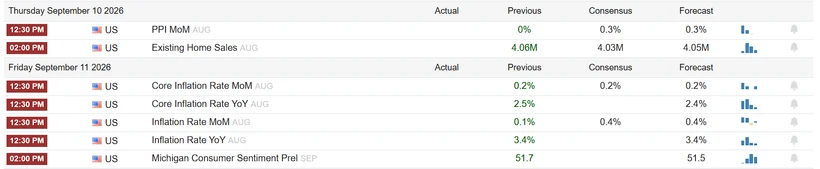
Second, this isn’t the number that decides it. Even the economists calling this strong are saying the same thing I am: next week’s inflation data is what really matters. We get PPI and CPI Thursday and Friday. If inflation comes in cool, the Fed can look at this jobs report and calmly set it aside. That’s the real fork in the road, not Friday.
Now let me zoom out, because when I stop staring at that one number and read the whole board, the picture is a lot calmer.
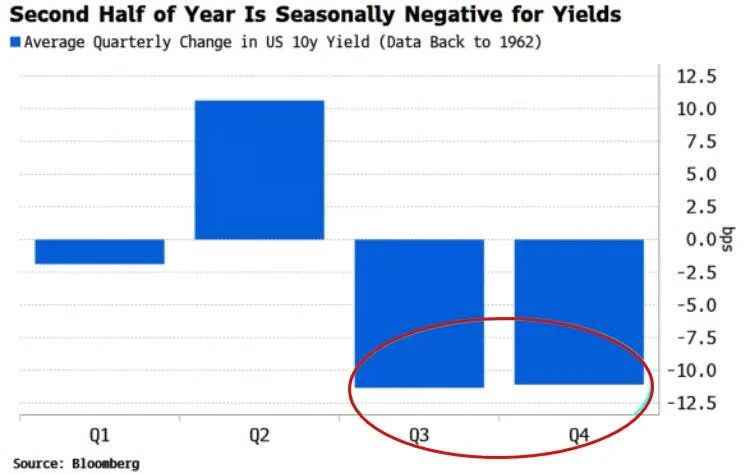
Chart 1: yields usually fall into year-end
There’s a Bloomberg chart going back to 1962 that shows how the US 10-year yield tends to move each quarter. The third and fourth quarters are seasonally the weakest for yields, meaning they usually drift lower, not higher. On average, both quarters have pulled yields down by around 10 basis points.
Why do I care? Because yields are the cost of money, and lower yields are oxygen for stocks. The jobs report pushed yields up on Friday, but the seasonal tide for the rest of the year usually leans the other way. One strong report doesn’t cancel that. It’s a good reminder not to extrapolate a single day into the whole autumn.
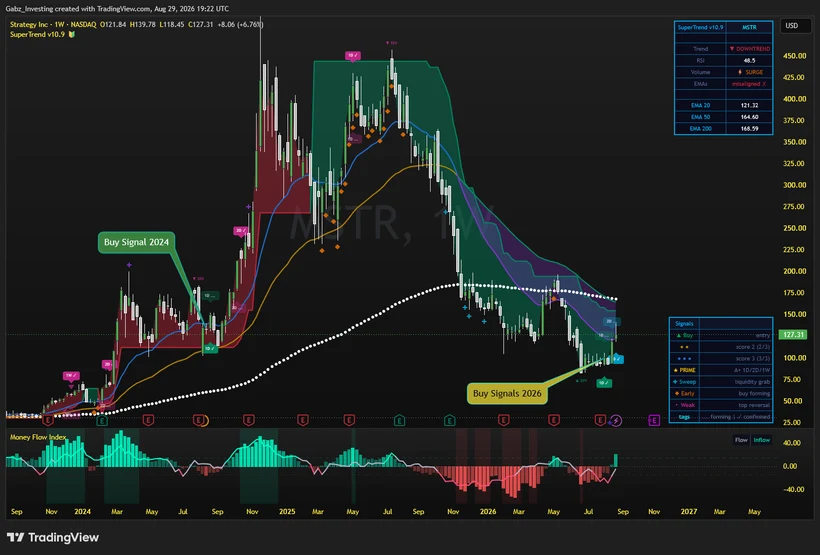
MSTR Just Triggered a Signal We Haven’t Seen Since 2024 — And History Was Explosive
The last time MSTR printed this type of BUY signal was in 2024.
What happened next?
+300%+ rally.
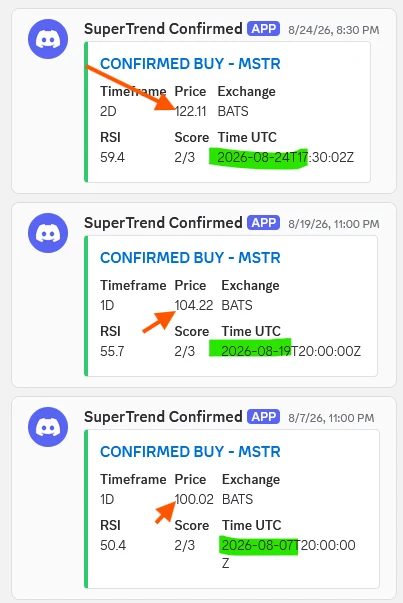
Now, a few days ago, we received the same type of signal inside our Discord channel, where 80+ Alpha & Beta members are following these setups.
And it wasn’t just one signal.
We got TWO.
And now… a THIRD signal has just appeared.
From the first signal to the highs reached on Thursday, MSTR is already up around 40%.
But in my view, this could be just the beginning.
The whole point isn’t to buy MSTR at every possible price.
It’s about waiting for the right setup and having the information to recognize when the risk/reward becomes favorable.
Information creates an edge.
If $50/month feels expensive, ask yourself a different question:
How much could you have saved simply by not buying MSTR at every price level, and instead waiting for the moments when the setup was actually favorable?
You don’t need to catch every move.
You need to recognize the high-quality ones.
And sometimes, one good setup can pay for a lot more than a subscription.
Whoever has the information has the power.
Not financial advice. Do your own research.
Your Biggest Investing Mistake Isn’t the Stock — It’s Your Behavior
The recurring ones:
Chasing performance. Buying what already ran 200% because it’s “obviously going higher.” You’re usually buying the top of a crowded trade from the people who got in early.
Letting emotion drive entries and exits. Panic-selling the bottom, FOMO-buying the top. The market is a machine for transferring money from the impatient to the patient — most people trade against themselves.
No position sizing or risk plan. Going all-in on one name, or sizing so big that a normal drawdown forces you to sell at the worst moment. How much you bet matters more than what you bet on.
Confusing a great company with a great stock. A fantastic business bought at an absurd valuation can still lose you money for years. Price paid determines your return, not the quality of the story.
Only reading the bull case. Confirmation bias. If you can’t articulate the strongest bear argument against your position, you don’t actually understand the trade — you’re just hoping.
Overtrading. Fees, taxes, spreads, and bad timing quietly eat returns. Most portfolios would do better with less activity, not more.
Refusing to sell losers / anchoring to purchase price. “I’ll sell when it gets back to breakeven.” The market doesn’t know or care what you paid. Holding a broken thesis because you’re underwater is not patience — it’s denial.
Recency bias. Assuming whatever just happened will keep happening — extrapolating a bull run forever, or staying frozen in cash after a crash.
Ignoring what you can’t see. Dilution, insider selling, non-cash “profits,” debt maturities. The headline number is often the least important part.
Following finfluencers without receipts. Taking calls from accounts that only post wins and quietly delete losses. No timestamped track record = no accountability.
The through-line: the biggest edge for most people isn’t a better indicator, it’s temperament, doing the homework, and sizing so you survive being wrong.