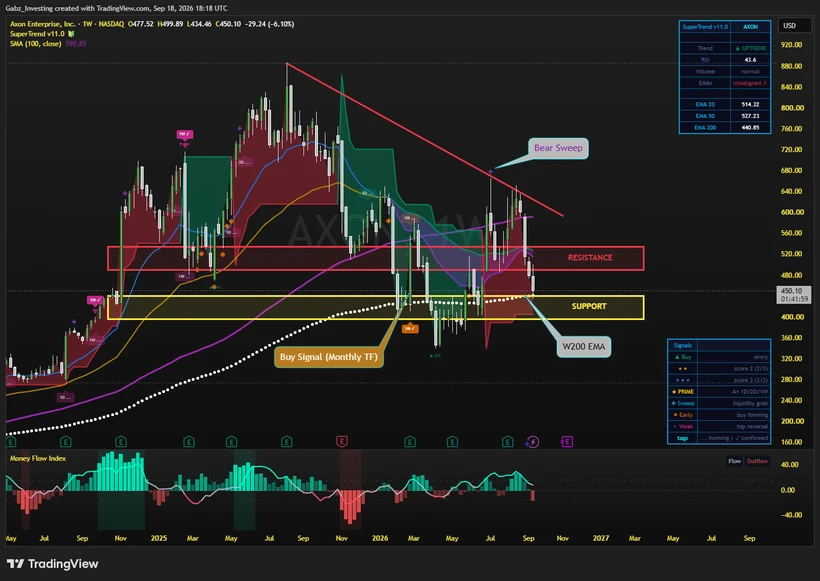
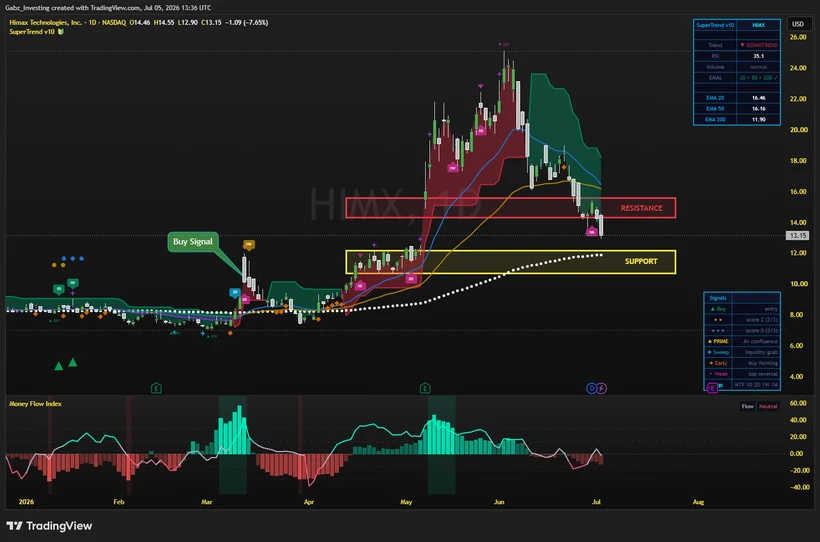
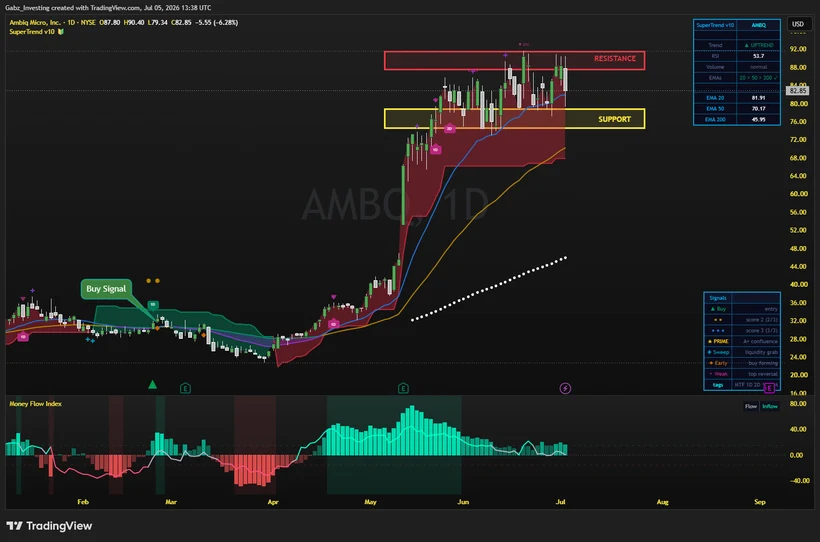
If I had a larger cash reserve today, these are some of the companies I would be watching very closely for the next opportunities.
And there is an important distinction here:
I’m not looking to chase momentum. I’m looking for quality companies at better prices — and speculative companies at levels where the risk/reward becomes interesting.
Some of these names are mature businesses that I would be comfortable holding for years. Others are much more speculative and would only deserve a smaller allocation in a portfolio.
🟢 QUALITY / LONG-TERM
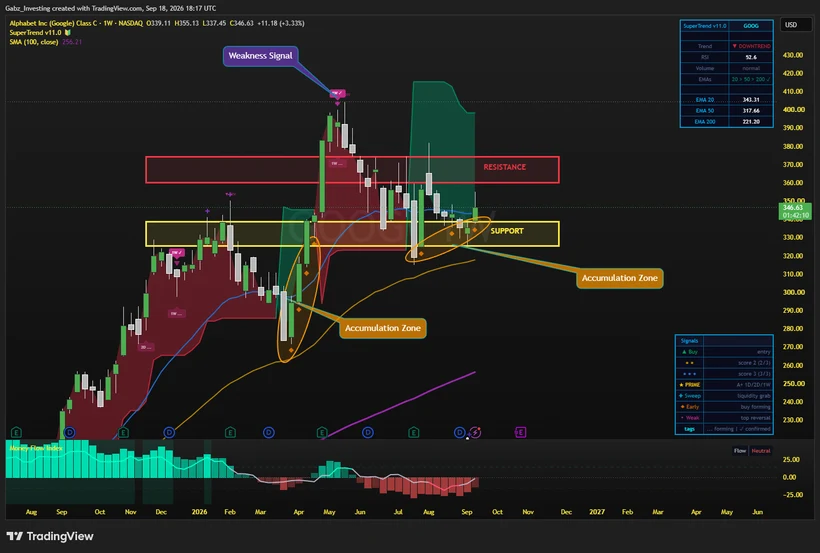
Google ($GOOG)
One of the most interesting accumulation zones on my watchlist right now. Support: $338–325 Resistance: $360–374 MFI remains negative, but selling pressure continues to decline and flow is neutral. The orange accumulation diamonds have historically appeared before periods of renewed momentum.
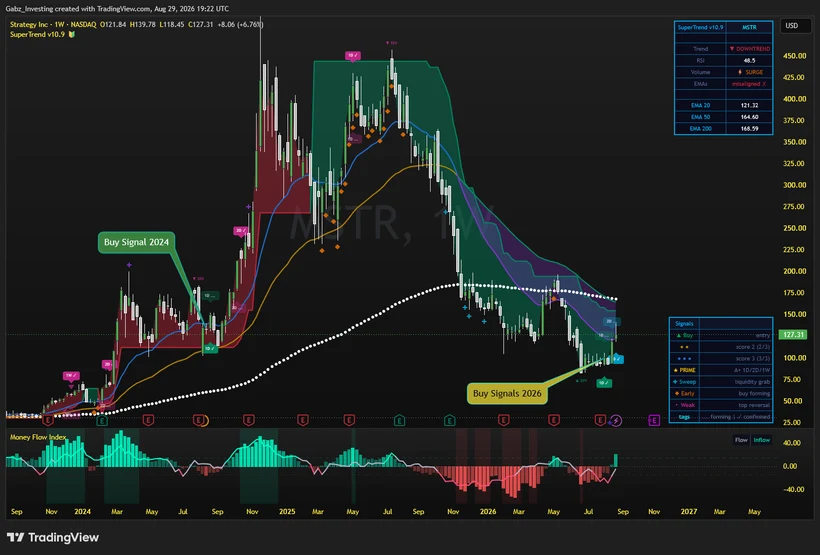
MSTR Just Triggered a Signal We Haven’t Seen Since 2024 — And History Was Explosive
The last time MSTR printed this type of BUY signal was in 2024.
What happened next?
+300%+ rally.
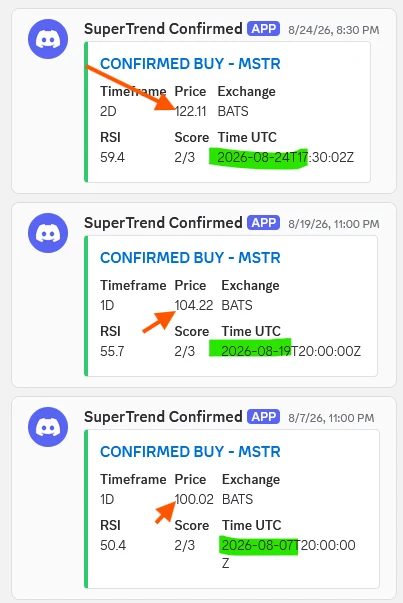
Now, a few days ago, we received the same type of signal inside our Discord channel, where 80+ Alpha & Beta members are following these setups.
And it wasn’t just one signal.
We got TWO.
And now… a THIRD signal has just appeared.
From the first signal to the highs reached on Thursday, MSTR is already up around 40%.
But in my view, this could be just the beginning.
The whole point isn’t to buy MSTR at every possible price.
It’s about waiting for the right setup and having the information to recognize when the risk/reward becomes favorable.
Information creates an edge.
If $50/month feels expensive, ask yourself a different question:
How much could you have saved simply by not buying MSTR at every price level, and instead waiting for the moments when the setup was actually favorable?
You don’t need to catch every move.
You need to recognize the high-quality ones.
And sometimes, one good setup can pay for a lot more than a subscription.
Whoever has the information has the power.
Not financial advice. Do your own research.
PART I – 10 Ways to Play Robotics in 2026 | Deep Dive Reference
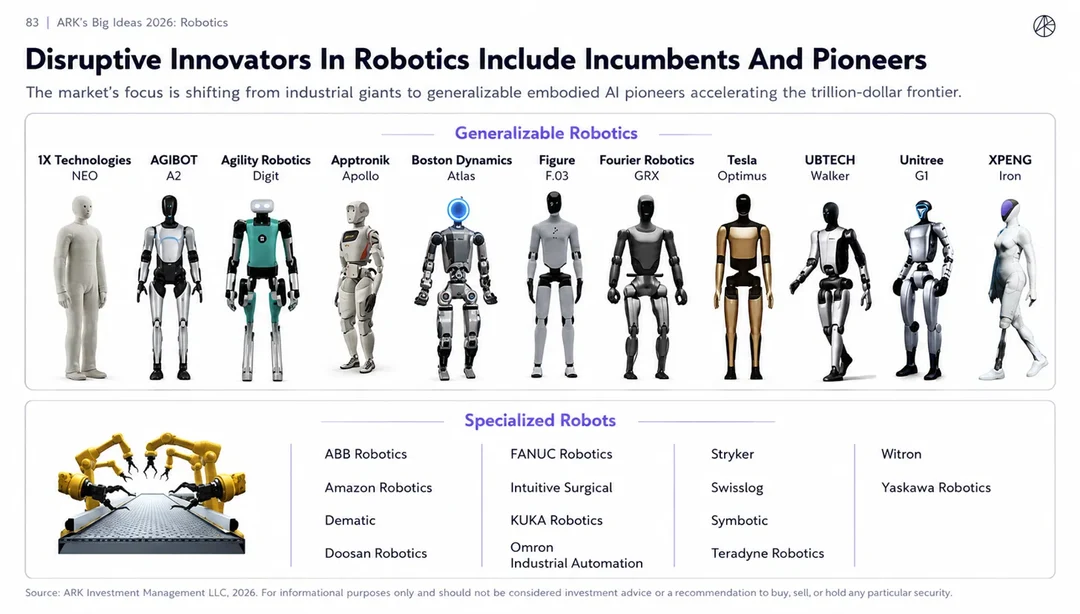
Source: ARK Investment Management LLC, Big Ideas 2026.
10 Ways to Play Robotics in 2026 — Part 1: The Enablers
A slide from ARK’s Big Ideas 2026 has been making the rounds, and a list of “10 robotics stocks” has been circulating on X alongside it. I’ve seen versions of this list shared thousands of times — and almost nobody sharing it has actually looked under the hood of these companies.
So I did. I went through all ten names, chart by chart, filing by filing, and fact-checked every claim. Two of them, as shared, are misleading enough that buying them blindly could cost you real money — one is a pending acquisition presented as done, and another isn’t even the company people think they’re buying. We’ll get to those.
But first, the framework. Robotics is not one trade. It’s a value chain: the brains and nervous system (edge AI silicon), the senses (lidar, vision, force sensing), the tools and test bench, and finally the deployed platforms — the robots themselves. The further down that chain you go toward the actual robot, the bigger the potential prize and the higher the failure rate. The enabler layer is where profitable businesses win no matter which robot brand wins. The platform layer is where fortunes get made and burned.
In this first part, I’m covering five names that sit mostly in that enabler layer — the companies selling the picks and shovels of physical AI.
In Part 2, we move down the chain into the platforms, including the two names where the popular narrative gets it wrong.
Let’s start.
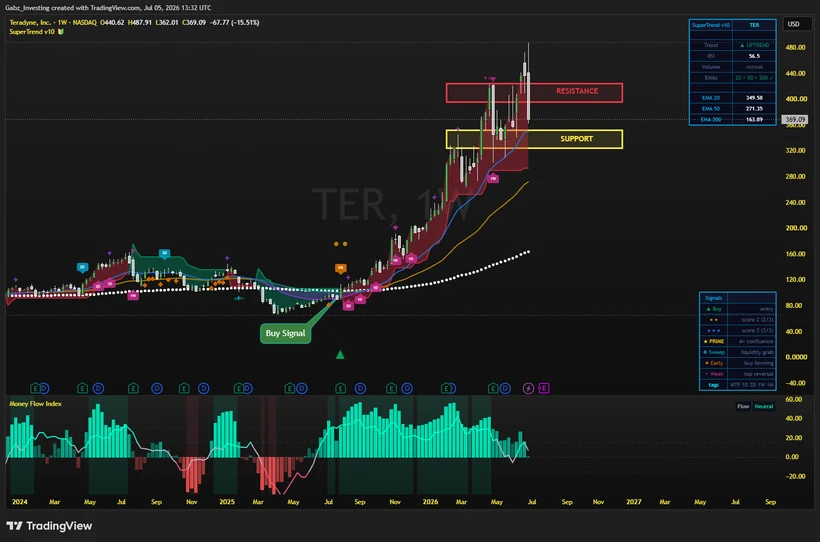
1. TERADYNE ($TER) — The Test Layer + Cobots
What they do: Global leader in automated test equipment (ATE) for semiconductors — every advanced AI chip, HBM memory stack, and networking processor has to be tested before shipping, and Teradyne is one of two companies (with Advantest) that dominate that market.
Robotics angle: Owns Universal Robots, the world’s leading collaborative robot (cobot) brand, acquired in 2015, plus MiR (autonomous mobile robots, acquired 2018). This makes TER a rare two-engine story: AI chip testing plus factory-floor robotics.
Why it matters in 2026: The AI capex cycle directly feeds the test business — more HBM, more custom silicon, more compute means more testers. The robotics segment gives optionality on the industrial automation recovery.
The catch: The robotics division has been the weak engine for several years — cyclical industrial demand in Europe and China has dragged on Universal Robots’ growth. The stock trades primarily on the semiconductor test cycle, not on robots.
Financial profile: Large cap, profitable, strong balance sheet, consistent buybacks. Quality compounder profile rather than speculative play.
Risks: Semi test is cyclical; robotics segment margin dilution; competition from Advantest in AI-related test.
On the chart: Watch how it trades relative to the semiconductor cycle (SMH correlation is high). Robotics news rarely moves it — earnings and test bookings do.
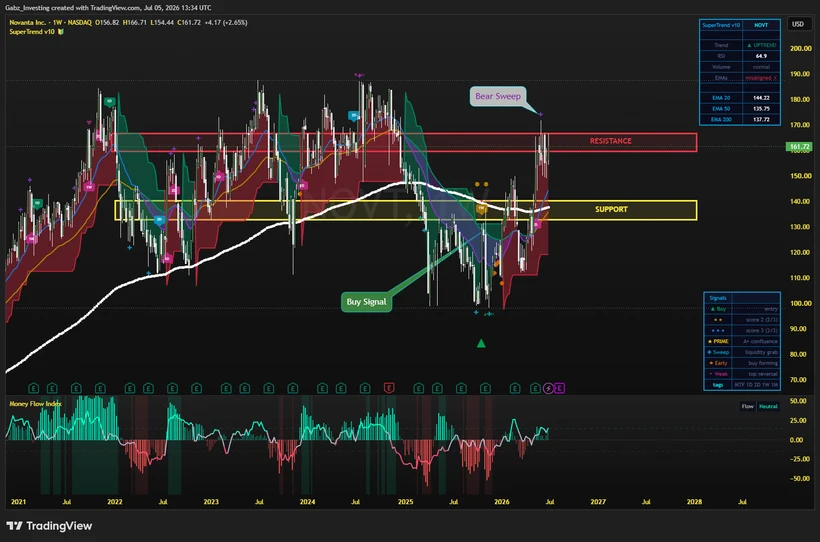
2. NOVANTA ($NOVT) — Precision Photonics Inside the Machines
What they do: Designs photonics, precision motion control, and vision components — lasers, beam delivery, optical encoders, mirrors — that go inside other companies’ machines.
Robotics angle: Their components sit inside surgical robots (medical is their largest end market — think robotic surgery platforms), industrial automation, and precision manufacturing equipment. A classic picks-and-shovels position: they win regardless of which robot brand wins.
Why it matters in 2026: Surgical robotics is one of the few robotics verticals with proven, profitable, recurring adoption. Novanta rides that installed-base growth without carrying platform risk.
Financial profile: Roughly a billion dollars in annual revenue, consistently profitable, serial acquirer with a disciplined M&A playbook. Mid-cap quality name.
The catch: Not cheap historically — the market has long recognized the quality. Growth is steady, not explosive.
Risks: Customer concentration in medical OEMs; industrial end-market softness; valuation compression if growth slows.
On the chart: Behaves like a quality industrial compounder. Look for entries on broad market drawdowns rather than expecting momentum breakouts.
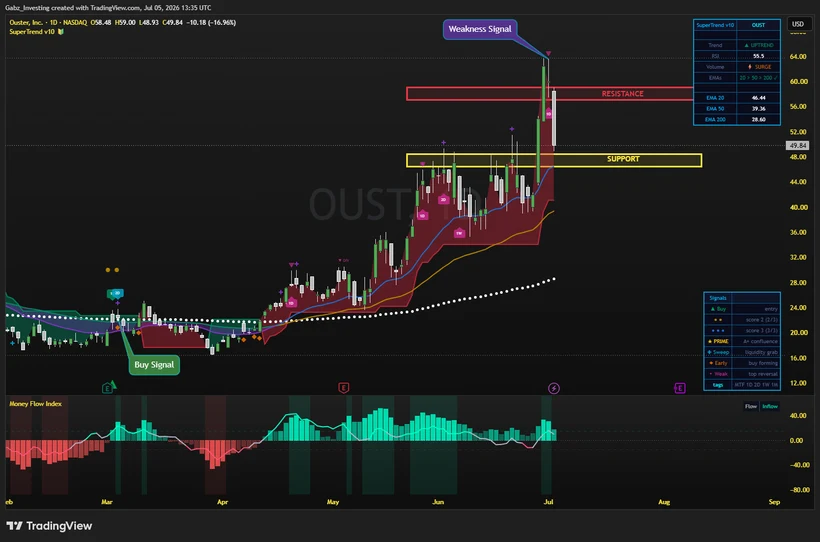
3. OUSTER ($OUST) — The Eyes
What they do: Digital lidar sensors — the 3D “eyes” that let machines see, map, and navigate the physical world. Merged with rival Velodyne in 2023, consolidating the Western lidar market.
Robotics angle: Lidar is the perception layer for autonomous mobile robots, industrial vehicles, smart infrastructure, and increasingly humanoids. Ouster’s digital architecture (silicon-based, improving on a chip cadence like Moore’s Law) differentiates it from legacy analog lidar.
Why it matters in 2026: Every physical AI machine needs to perceive its environment. Ouster is diversified across industrial, robotics, smart infrastructure, and automotive — not a single-market bet like many failed lidar SPACs.
Financial profile: Small cap, revenue growing at a healthy double-digit clip, improving gross margins, but not yet profitable. Cash position matters — check the latest quarterly for runway.
The catch: The lidar sector has a graveyard of failed companies. Ouster is a survivor, but survival is not the same as durable profitability.
Risks: Dilution history typical of the sector; Chinese lidar competition (Hesai) on price; path to profitability still in progress. Apply the dilution lens here — share count trajectory is part of the thesis.
On the chart: High beta, sentiment-driven. Trades with the speculative robotics/physical-AI basket. Position sizing discipline is essential.
4. HIMAX ($HIMX) — Vision Chips at the Edge
What they do: Taiwanese fabless semiconductor company. The bread-and-butter business is display driver ICs (screens for phones, cars, monitors) — the growth story is WiseEye, their ultra-low-power AI vision sensing platform.
Robotics angle: WiseEye enables always-on machine vision at milliwatt power levels — cameras that see, detect, and process images locally without draining a battery. Relevant for robots, smart devices, and edge AI endpoints processing depth and sensor inputs.
Why it matters in 2026: It’s an optionality story: you buy a mature, cash-generative display driver business and get the edge AI vision kicker at a low multiple.
Financial profile: Profitable, pays a meaningful annual dividend (variable, tied to prior-year earnings), cheap on traditional metrics compared to anything with “AI” in the description.
The catch: The core display driver business is cyclical and tied to consumer electronics demand and China exposure. WiseEye is still a small fraction of revenue.
Risks: Taiwan geopolitical exposure; display cycle downturns; the AI optionality taking longer to become material.
On the chart: Historically prone to violent rallies on AI narratives followed by long consolidations. Better accumulated in the quiet periods than chased in the spikes.
5. AMBIQ ($AMBQ) — The Low-Power Intelligence Layer
What they do: Fabless semiconductor company from Austin, listed on NYSE in July 2025. Their proprietary SPOT technology (Subthreshold Power Optimized Technology) runs chips at near-threshold voltages, enabling AI compute at a fraction of normal power consumption.
Robotics angle: Robots and edge devices need always-on intelligence without burning energy. Ambiq’s Apollo SoCs and the new Atomiq NPU chip (unveiled January 2026, over 200 GOPS of on-device AI) target exactly that layer — wearables, sensors, and battery-constrained smart machines.
Why it matters in 2026: Power is the binding constraint of edge AI. If intelligence is moving into millions of small devices, the lowest-power silicon wins share structurally.
Financial profile: Ended Q1 2026 with roughly 204 million dollars in cash and no debt, giving real runway. But the company still burns cash and is not yet profitable.
The catch: Recently IPO’d, richly valued for its revenue base, and carries customer concentration risk. This is a technology-lead story that still has to prove commercial scale.
Risks: Cash burn; customer concentration; competition from giants (Qualcomm, STMicro, Nordic) moving down the power curve; a June 2026 securities offering filing signals potential dilution — watch the share count.
On the chart: Young public history means limited technical structure. Expect IPO-typical volatility, lockup-related supply events, and narrative-driven swings. Small position sizing only.
PART I – Covers the enabler layer — the eyes, the low-power brains, the precision components, and the test bench that every robot chip has to pass through.
In Part 2, we go where the real risk and the real upside live: the edge AI stack being assembled through a 7 billion dollar acquisition, the warehouse automation pure play with a backlog most companies can only dream of, the trillion-dollar humanoid bet, and the SPAC that everyone is calling a “pure play humanoid stock” — without understanding what they’re actually buying. That last one alone is worth the read.