
PART I – 10 Ways to Play Robotics in 2026 | Deep Dive Reference
July 5, 2026
10 Ways to Play Robotics in 2026 — Part 1: The Enablers
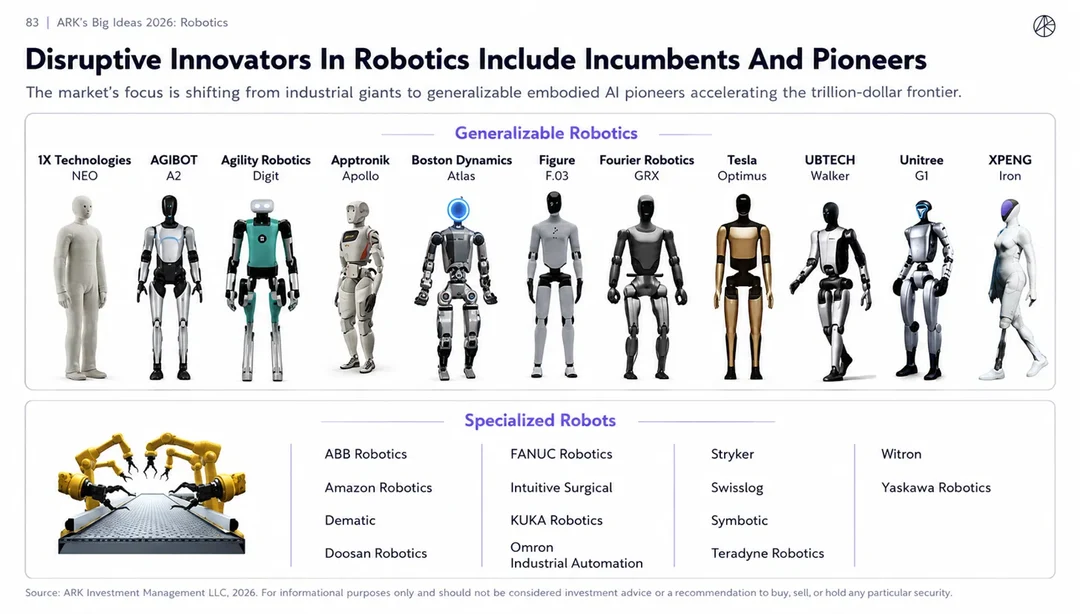
A slide from ARK’s Big Ideas 2026 has been making the rounds, and a list of “10 robotics stocks” has been circulating on X alongside it. I’ve seen versions of this list shared thousands of times — and almost nobody sharing it has actually looked under the hood of these companies.
So I did. I went through all ten names, chart by chart, filing by filing, and fact-checked every claim. Two of them, as shared, are misleading enough that buying them blindly could cost you real money — one is a pending acquisition presented as done, and another isn’t even the company people think they’re buying. We’ll get to those.
But first, the framework. Robotics is not one trade. It’s a value chain: the brains and nervous system (edge AI silicon), the senses (lidar, vision, force sensing), the tools and test bench, and finally the deployed platforms — the robots themselves. The further down that chain you go toward the actual robot, the bigger the potential prize and the higher the failure rate. The enabler layer is where profitable businesses win no matter which robot brand wins. The platform layer is where fortunes get made and burned.
In this first part, I’m covering five names that sit mostly in that enabler layer — the companies selling the picks and shovels of physical AI.
In Part 2, we move down the chain into the platforms, including the two names where the popular narrative gets it wrong.
Let’s start.
1. TERADYNE ($TER) — The Test Layer + Cobots
What they do: Global leader in automated test equipment (ATE) for semiconductors — every advanced AI chip, HBM memory stack, and networking processor has to be tested before shipping, and Teradyne is one of two companies (with Advantest) that dominate that market.
Robotics angle: Owns Universal Robots, the world’s leading collaborative robot (cobot) brand, acquired in 2015, plus MiR (autonomous mobile robots, acquired 2018). This makes TER a rare two-engine story: AI chip testing plus factory-floor robotics.
Why it matters in 2026: The AI capex cycle directly feeds the test business — more HBM, more custom silicon, more compute means more testers. The robotics segment gives optionality on the industrial automation recovery.
The catch: The robotics division has been the weak engine for several years — cyclical industrial demand in Europe and China has dragged on Universal Robots’ growth. The stock trades primarily on the semiconductor test cycle, not on robots.
Financial profile: Large cap, profitable, strong balance sheet, consistent buybacks. Quality compounder profile rather than speculative play.
Risks: Semi test is cyclical; robotics segment margin dilution; competition from Advantest in AI-related test.
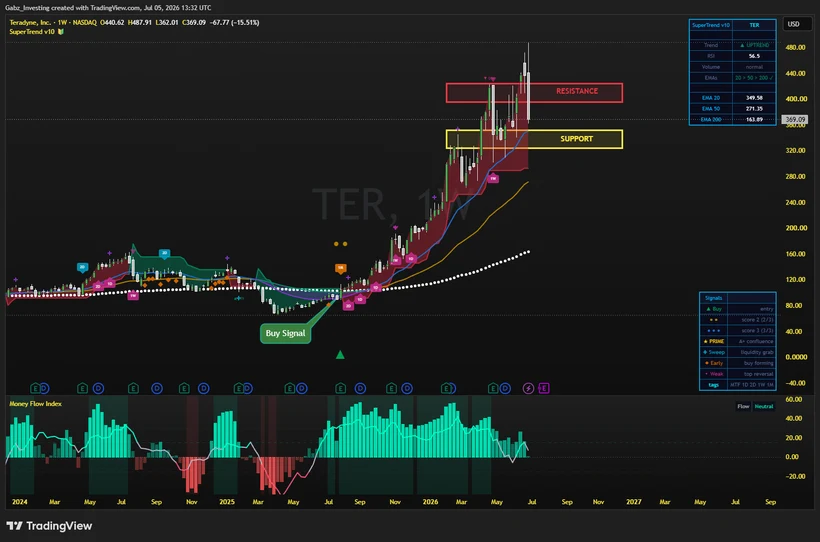
On the chart: Watch how it trades relative to the semiconductor cycle (SMH correlation is high). Robotics news rarely moves it — earnings and test bookings do.
2. NOVANTA ($NOVT) — Precision Photonics Inside the Machines
What they do: Designs photonics, precision motion control, and vision components — lasers, beam delivery, optical encoders, mirrors — that go inside other companies’ machines.
Robotics angle: Their components sit inside surgical robots (medical is their largest end market — think robotic surgery platforms), industrial automation, and precision manufacturing equipment. A classic picks-and-shovels position: they win regardless of which robot brand wins.
Subscribe to unlock the premium content
The rest of this article is for Gabz Investing members on Patreon.
Unlock on Patreon →