
September 20 | WEEKEND MINDSET: INVESTING NEEDS A PLAN, NOT PERFECTION
September 20, 2026
Good morning, Traders and Investors
Because it’s the weekend and there isn’t much market data to analyze — the market has taken a two-day break as well — today I want us to focus on something that may actually be more important than analyzing another stock: mindset, discipline, and having a clear investment plan.
If I had to build a healthy investment journey from scratch, I would start with one simple thing:
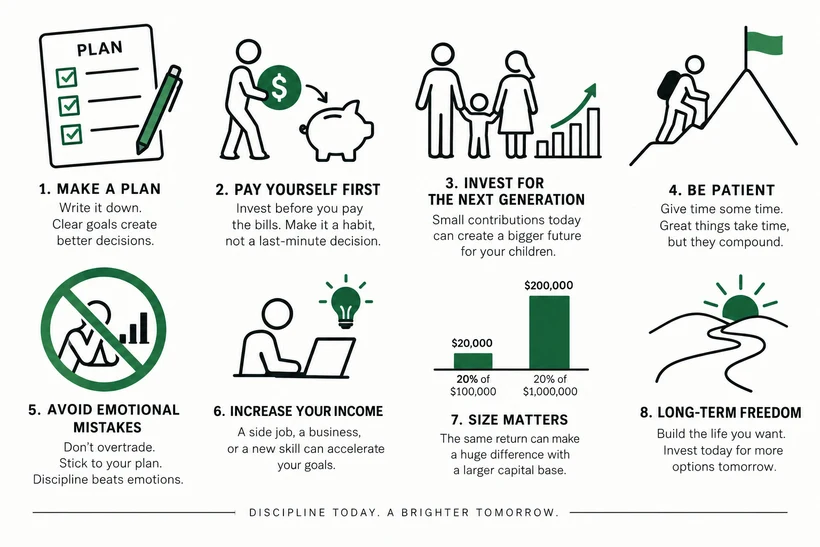
Make a plan.
And I don’t mean anything complicated. Take a piece of paper, old school, and write down:
- How much can I invest every month?
- What is my target?
- How long do I want to take to reach it?
- What annual return am I using as an assumption?
- What will I do when the market goes down?
- What will I do when the market goes up aggressively?
You’ve seen the compound interest calculator I’ve shared with you many times. Use it.
Enter the amount you can invest every month, choose a reasonable annual return assumption, and see what time and compounding can potentially do for your portfolio.
Of course, future returns are unknown. But we still need a framework so we can build a realistic plan.
PAY YOURSELF FIRST
Most people do the exact opposite.
They receive their salary → pay the bills → pay the debt → pay the mortgage → buy groceries → spend money on everything else → and then, at the end of the month, they see what is left for investing.
Very often, there is nothing left.
That’s why I suggest doing something different:
Pay yourself first.
The day you receive your salary, make the transfer to your investment or savings account.
Not at the end of the month.
Obviously, the amount has to be something you can realistically afford. There is no point investing money you need for essential expenses.
Personally, I have always considered 20–40% of a family’s monthly income, where financially possible, an ambitious target for saving and investing.
The important part is this:
Turn investing into a habit, not a decision you have to make every month.
THINK ABOUT THE NEXT GENERATION
Another thing I consider extremely important is building an investment account for your children.
If you have a child who is 1, 2, 3, or 5 years old, time is one of the biggest advantages you have.
You don’t need to start with huge amounts.
You could start with the monthly child allowance, a small recurring contribution, or whatever amount your family can comfortably afford.
This isn’t only about money.
It’s about changing the starting point for the next generation.
If we didn’t have that advantage when we turned 18, that doesn’t mean our children have to start from zero.
More details here!
STICK TO YOUR PLAN
If you create a plan, try to stick to it.
Don’t make exceptions every time the market moves in one direction or another.
Because one exception can very easily become a habit.
And long-term investing is, to a large extent, about repeating good habits for a very long time.
And perhaps most importantly:
Be patient.
Give time some time.
You don’t need to constantly buy and sell.
If you own companies you have strong conviction in and your investment thesis remains intact, avoid overtrading simply because you feel like you need to do something.
I have made these mistakes myself.
I sold part of my Palantir position around $30 before it went to $200
I sold part of my Robinhood position around $24 before it went to $100
I sold HIMS around $15 before it went to $70
I sold FROG around $25 before it went to $80
And then?
Some of these companies went on to increase dramatically.
The problem wasn’t only that I sold.
The problem was that I told myself:
“I’ll buy it back lower.”
And sometimes that lower price never came.
DON’T IGNORE YOUR MOST IMPORTANT ASSET: YOUR INCOME
If your current financial situation doesn’t allow you to invest as much as you would like, the solution may not be taking more risk in the market.
The solution may be to increase your income.
A part-time job.
A business.
Turning a passion into an additional source of income.
Learning a new skill.
Anything that can generate additional income that you can then direct toward your financial goals.
Because there is a massive difference between trying to achieve a higher return and being able to invest more money every single month.
MY OWN GOAL
I’m approaching 32 years old, with roughly one month left until my birthday.
My goal for many years has been $1 million. Thanks to this project, I have upgraded my goal to over $2M.
I don’t come from a wealthy family, and I didn’t start with a huge amount of capital. (If I told you that the average salary in my country is around $600, you would laugh or cry.)
I’m trying to build everything on my own.
And if my plan works the way I want it to, my goal is to reach a point around the age of 40 where I have the freedom to decide if, when, and how I want to work.
For me, that’s the real definition of financial freedom.
It doesn’t necessarily mean never working again.
It means not being forced to work simply because you need the next paycheck.
THEN COMES THE POWER OF CAPITAL
Once your portfolio reaches a certain size, the mathematics start to change.
A 20% return on $100,000 is $20,000. (Enough to live for 1 year in my Country)
A 20% return on $1,000,000 is $200,000. (Enough to live at least 5 years with a great lifestyle)
Same percentage.
Completely different capital base.
That’s why, during the first part of the journey, I believe we should focus heavily on:
Contributions + Discipline + Time + Increasing Income.
Later, when the capital becomes large enough, there are more ways to potentially generate cash flow — dividends, options strategies, and other instruments, depending on your experience, risk tolerance, and objectives.
But we don’t need to jump straight to the end of the story.
We need to build the foundation first.
Plan → Contributions → Discipline → Time → Compounding.
That’s what today’s material is really about.
Not what the market will do on Monday.
Not which stock will go up next week.
It’s about you.
About what you can control.
Because the market doesn’t require you to be perfect.
It requires you to avoid making the same emotional mistakes over and over again.